


A customer may now ask an AI tool to explain a problem, compare services, or suggest what to consider before hiring a business. They might reach your website through a supporting link, look up your name later, or make a decision without following the same path as a traditional search.
That is worth paying attention to. It is also a good reason to be careful with promises about “ranking in AI.” A mention in one answer is not a permanent position, and a report showing a few sample prompts is not a record of what every potential customer sees.
Start with the information a customer needs
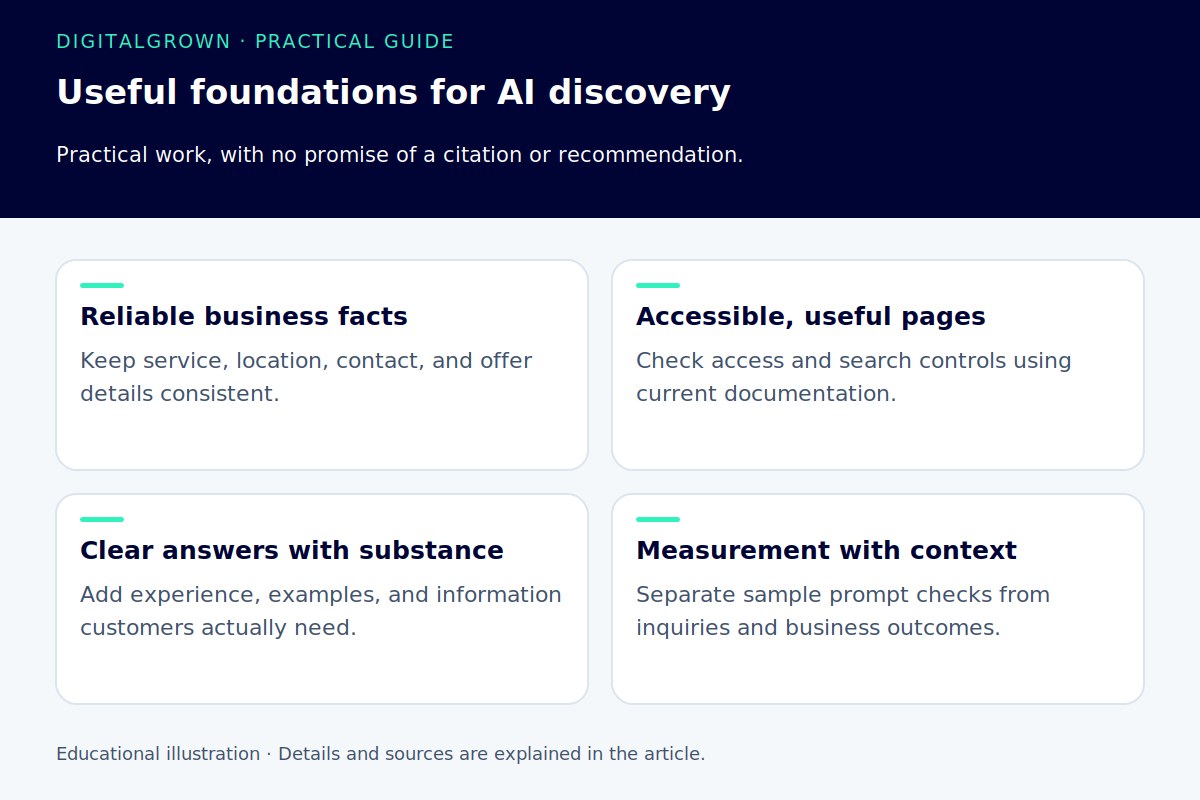
Make it clear what your business does, who it serves, and what makes an inquiry worthwhile. Keep contact details and service information consistent across your website and the profiles you manage. Explain important limits, requirements, and the steps involved in becoming a customer.
Then add the information a generic summary cannot supply. What do you normally ask before quoting? Which option is suitable in which situation? What does the service include? Where do customers commonly misunderstand the process? Real examples and careful explanations give people a reason to use your page as a source.
Google’s guidance for generative AI search emphasizes useful, distinctive content and warns against producing many repetitive pages simply to cover every possible query variation. That is a reason to improve the substance of a page, rather than multiply slightly different versions of it. [1]
Give useful answers a clear structure
Use a descriptive heading, answer the main question promptly, and organize the detail under headings a reader can understand. Put essential facts in normal text. Support them with relevant images, demonstrations, or tables where those make the explanation clearer.
For example, a service page could explain the situations you handle, the area covered, the information needed for an estimate, and how the process works. A supporting article can explore a narrower question. These pages can link to each other without turning either into a repeated list of promotional claims.
This is an editorial approach, not a promise that a particular answer format will secure a citation. A long FAQ is not automatically better than a short page that answers the real question properly.
Check access before chasing special tactics
For Google’s AI search features, its AI-features documentation describes indexed pages eligible for snippets as the technical baseline. It does not require a special AI schema type or a new machine-readable text file. Helpful content still needs to be accessible and connected to the rest of the site. [2]
Have the relevant developer review crawler access, indexability, snippet permissions, and any site-level AI controls currently available for your property. Google’s guidance and controls continue to develop, so use the current documentation and the settings available in your own account.
Other AI services can have different access rules, products, and reporting. Do not assume that a setting for one service controls every AI system, or that permission for search inclusion is the same as permission for every other use. Decide what you want to make available, then configure those choices deliberately.
Keep business facts consistent
If one page says you serve one area and another implies a much wider service, the inconsistency can confuse people regardless of the discovery platform. The same applies to opening hours, pricing that has changed, discontinued services, or an old phone number.
Review your Google Business Profile and the directories that matter to your customers. DG Listing Sync Pro can help maintain information across supported publishers. That is useful listing-management work; it should not be described as a guarantee that an AI answer will recommend your business.
Separate visibility checks from business results
A sample-prompt check can show whether a business appeared in a particular answer at a particular time. Record the prompt, service, date, and context if you use this kind of research. Do not treat changes in a small prompt set as a precise market-share measurement.
Google reports traffic from its AI search features within the Search Console Web performance data described in its documentation. That data does not automatically become a separate list of every AI answer that mentioned you. Review the available reporting before assigning a change to one feature. [2]
Look at relevant referral sources, useful landing-page visits, completed inquiries, and what customers tell you about how they found you. A direct visit after someone saw your name elsewhere may not reveal that earlier discovery step. Measurement has gaps; a tidy dashboard does not remove them.
Choose work that remains useful as the tools change
A sensible first project is to improve one important service page, correct inconsistent facts, and publish an article answering a question customers actually ask. Keep evidence for factual claims and review older pages when the information changes.
If you use AI while drafting, check the details and add your own knowledge before publication. A polished paragraph can still contain an invented feature, a misleading comparison, or advice that does not fit your business. The value comes from the decisions and review behind the content.
Our content and on-page optimization work focuses on clear, useful pages, while analytics and research helps put the available evidence in context. Those are practical foundations for discovery through search, AI-assisted answers, and the people who recommend you.


