


An online store needs more than a collection of product pages. Customers need to find the right category, understand an item, choose an available option, and complete the purchase without surprises. Search visibility depends on making the products discoverable and understandable too.
The most useful first review usually covers a few foundations across the store, rather than adding a new tactic to every product. Start with how the catalog is organized and whether the information agrees from browsing through checkout.
Give products a sensible route from the homepage
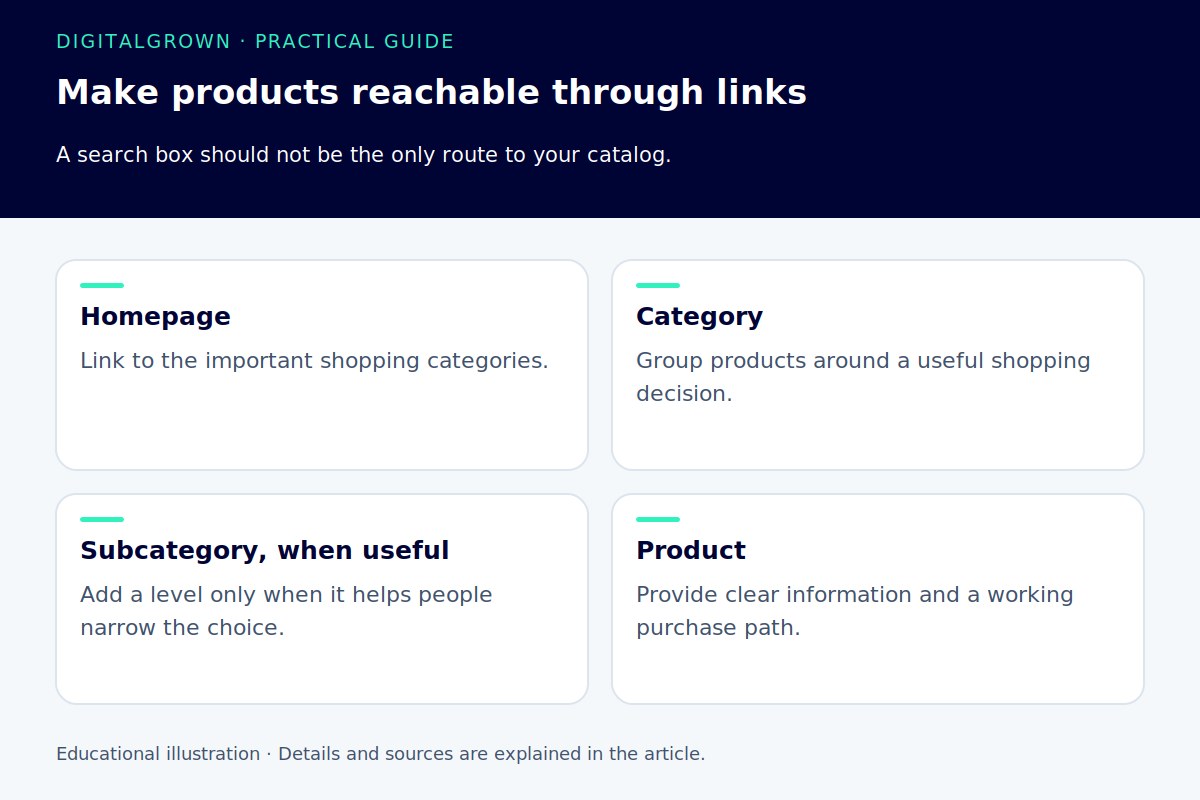
Organize the store around the ways customers look for its products. Clear categories and useful subcategories help someone narrow the choice without needing to know the exact product name in advance.
Link from categories to the products you want discovered. Google’s ecommerce guidance explains that its crawler generally does not submit a store’s search form to find products, so a product available only through on-site search may be hard to discover by crawling. [1]
For a hypothetical outdoor shop, a path from Bags to Daypacks to a specific backpack is easier to understand than an unstructured list of every item. The most useful organization depends on the range and the customer, not a rule that every store needs the same number of levels.
Make product pages useful enough to buy from
Explain the actual product, not just the broad category it belongs to. Include accurate specifications, materials, dimensions, compatibility, available choices, and the practical questions that would otherwise stop someone from ordering.
Use photographs that help the customer inspect the relevant details. A product shown in context can explain scale or use, while a close-up may answer a question about a component or finish. Add alternative text that describes the useful information rather than a list of search phrases.
State the available price and stock information clearly, and make shipping and return information easy to find. Do not make customers begin checkout just to discover a limitation that changes their decision. Our guide to better product pages provides a more detailed content review.
Keep visible information and product data aligned
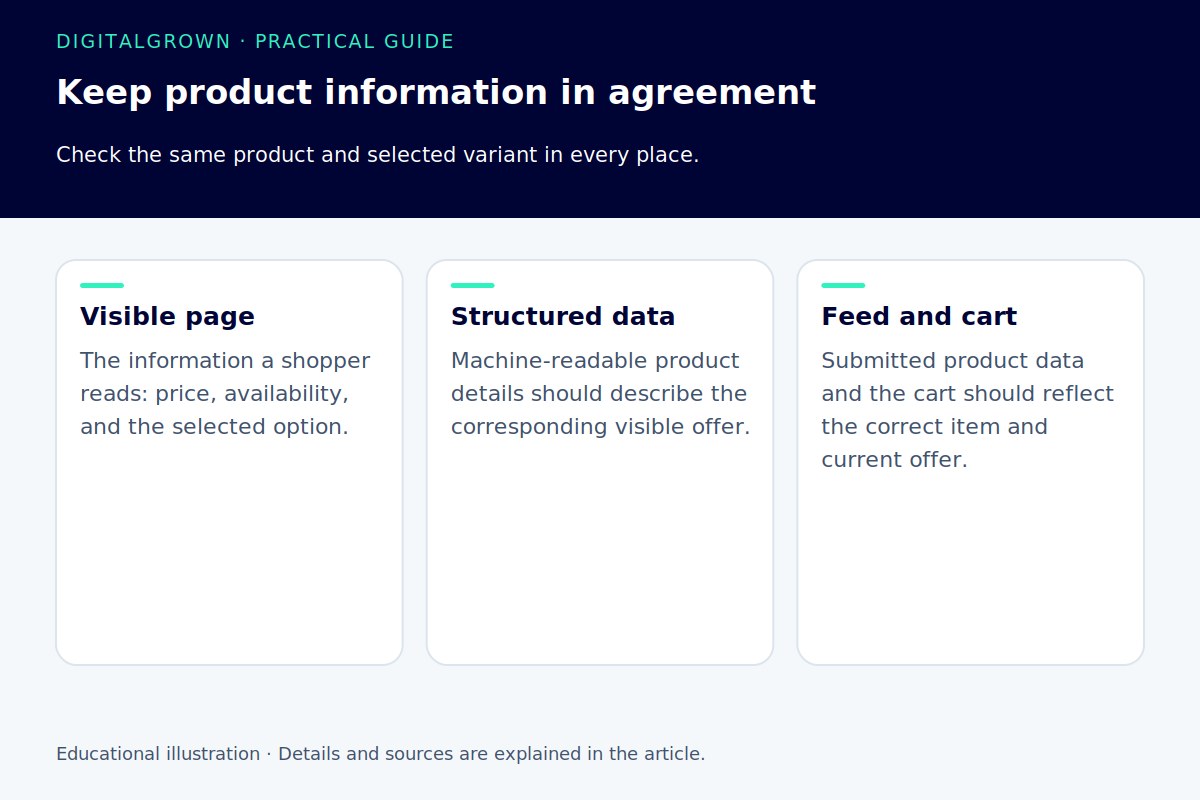
Search engines and shopping services can receive product information through the website, structured data, and product feeds. Google’s guidance describes using structured data and Merchant Center to provide product information beyond ordinary page discovery. [2]
These are connected representations of the same offer. A changed price or discontinued variant should not leave contradictory information in a feed, a product page, and the cart. Assign responsibility for the catalog data and check the systems that publish it.
Suitable merchant-listing structured data can help Google understand product and offer details. The implementation should match the visible product information and satisfy the requirements for the relevant feature. Adding markup is not a guarantee of a particular search appearance. [3]
Keep URL and variant decisions understandable
Review which addresses represent products, categories, variants, and filter combinations. A clear URL design helps the store stay manageable, but the navigation and page relationships also need to make sense. Changing a URL pattern alone will not repair a disconnected catalog.
Google has ecommerce URL guidance covering product variants and parameters. Work with the platform’s behavior rather than rewriting every address on a live store without a plan. When established URLs change, account for old links and relevant redirects. [4]
Test a shared product link and a selected variant on another device. The customer should reach the product or option they expected. This is especially useful after theme, catalog, or filtering changes.
Test the mobile buying journey
Do more than resize the homepage. Open a category, use the filters, inspect product images, choose a variant, add it to the cart, and complete an appropriate test purchase in the store’s test workflow.
Look for practical obstacles: an option hidden below an oversized image, an unresponsive quantity control, a surprise shipping restriction, or a payment step that fails. Good performance matters during interaction as well as the initial page load.
A store can display a polished front page while the product or checkout templates have different performance and usability problems. Include those templates in your performance review instead of judging the whole business by one test score.
Promote the store without buying a link problem
Relevant supplier directories, genuine editorial coverage, and useful collaborations can introduce products to potential buyers. Evaluate the audience and the contribution rather than treating every mention as a ranking asset.
Keep paid promotion transparent and avoid arrangements built around manipulating search rankings. Our off-page SEO guide explains that distinction and the questions worth asking before pursuing a placement.
Measure the steps that affect the business
Review discovery, product interest, checkout progress, completed orders, and the customer questions your team receives. If a popular product page repeatedly attracts the wrong audience or generates the same unanswered question, improve the explanation rather than simply buy more visits.
Choose a small set of important categories and products for the first pass. Fix the issues that block understanding, discovery, or a purchase, then apply the useful changes across the relevant templates. That gives the store a stronger foundation for future content and marketing.


