


Your website can explain your business well, but it is not the only place people learn about you. A trade organization, supplier, local publication, directory, or customer can introduce you to an audience that already has a reason to care.
Off-page SEO covers work beyond your own pages that supports your visibility and reputation. Links are part of that picture, but collecting links without considering the source, the audience, and the reason for the mention is a poor way to make decisions.
Start with relevance and a real audience
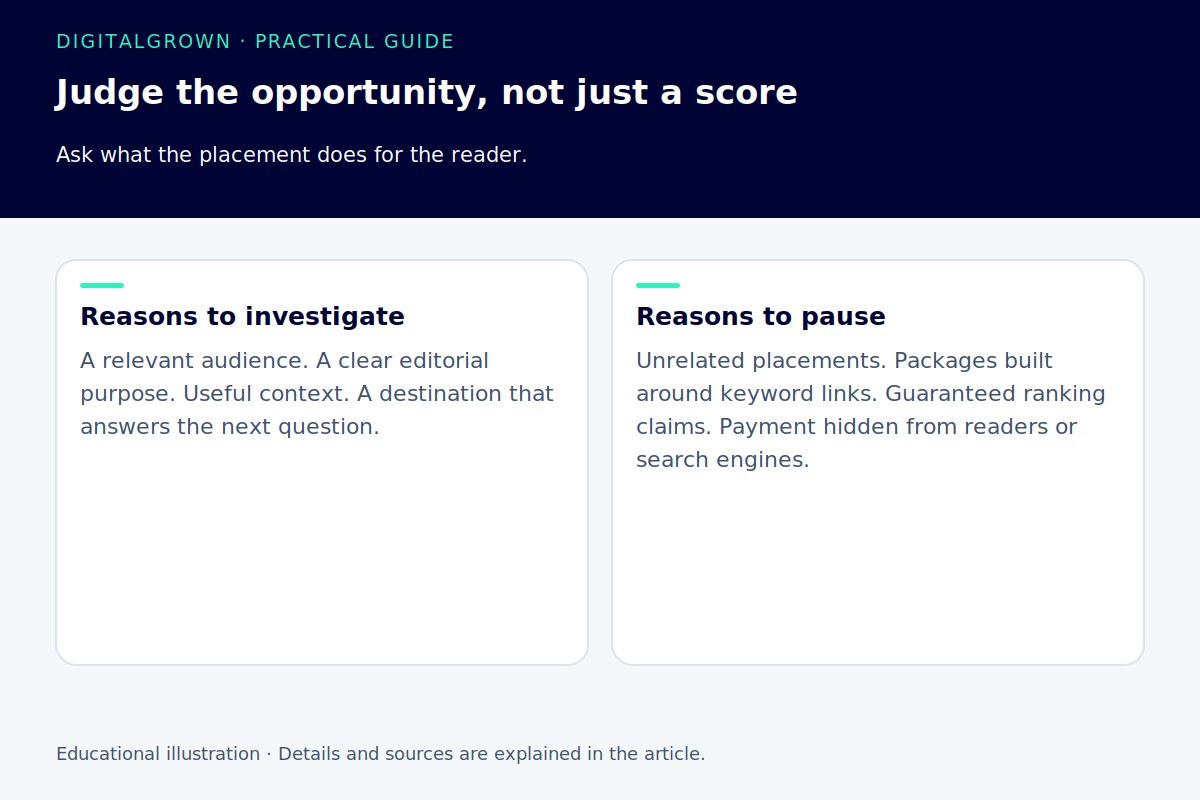
Before pursuing a placement, ask who uses the site and what they are looking for. A relevant trade directory or supplier’s stockist page can be a more sensible opportunity than a generic site promising a large authority score.
Inspect the publication itself. Does it have a clear subject and useful content? Are there real businesses or people behind it? Would the link help a reader understand or find something? A third-party score can be one research input, but it cannot answer those questions for you.
For a hypothetical local installer, a manufacturer’s approved-provider directory could help people find an appropriate service. A page containing hundreds of unrelated businesses and keyword-filled links deserves a different assessment, even if someone offers a reassuring report about it.
Give people a reason to mention the business
Think about useful relationships you already have: suppliers, professional organizations, event partners, customers willing to discuss a project, and local groups you genuinely participate in. Check that their references to your business are accurate and point to a relevant destination.
A practical resource can also earn attention. You might explain a process people regularly misunderstand, publish an original comparison based on work you can substantiate, or provide a clear answer that another organization’s audience needs. The useful contribution comes first; a link may follow.
Do not invent a study or dress a generic list up as first-hand research. If you publish a project example, get permission for the information you use and explain the actual scope. A smaller, well-supported example is more valuable to a reader than a dramatic claim with no evidence.
Treat guest content as a contribution
Writing for another publication can make sense when you can help its audience. Agree on a useful subject, provide an original contribution, and link only where a reader would benefit. A relevant author biography or resource link can provide a natural next step.
The reason for a guest article matters. Google’s spam policies identify link schemes intended to manipulate rankings, including certain paid placements, excessive exchanges, and optimized links in large-scale guest-post campaigns. Buying a package of keyword-rich links is different from contributing something useful. [1]
When a link is an advertisement or paid placement, it should be appropriately qualified. Google recommends rel="sponsored" for paid links and accepts nofollow as a way to flag them. A commercial arrangement can still have marketing value without being presented as an earned editorial endorsement. [2]
Keep local information and reputation accurate
For a local business, the basics are still worth maintaining: the correct business name, phone number, website, and relevant operating information on places customers actually use. Fixing a wrong number can matter more than adding another obscure directory.
DG Listing Sync Pro helps manage business information across supported publishers and review supported duplicate listings. It works well alongside DG Local SEO tracking, which helps you follow changes in Maps and organic positions. They solve related management tasks, rather than serving as a promise of a particular ranking.
Keep an honest review routine as well. Customer feedback helps other people judge the business. Treat it as customer service and reputation work, with useful replies and follow-up, rather than a way to manufacture a perfect-looking profile.
Promote useful work where it belongs
Share an article with an organization, newsletter, or community when it answers a question its members have. Take part in conversations without making every answer an advertisement. Follow the community’s rules, and leave the link out when the answer can stand on its own.
Social activity can distribute information and introduce the business to people who would otherwise miss it. Judge the activity by the audience and response it produces. A large count of likes is not a substitute for evidence that the right people found something useful.
Review outcomes beyond the link count
Keep a simple record of worthwhile placements, relationships, and referrals. Review which destinations people visit and whether they lead to relevant inquiries. Some activity builds recognition without an immediately measurable click, so keep the business context alongside the reports.
Our guide to bringing relevant visitors from other websites explains how to plan the destination and measure the response. Off-page work is stronger when the page people arrive on is clear and useful too. If the customer still cannot tell what you offer, another link will not fix that experience.


